Saturday, July 23, 2005

On Kilt Hose...


One of the articles of clothing I get asked about most often by men putting together their first kilt ensemble is the hose. Yet surprisingly little has been written about them. That doesn’t stop people from having some rather strong opinions about just what is and is not “correct.” So time to tackle the garment that everyone knows is worn under the kilt – the socks!

To begin with, let’s take a step back into history and look at the very first type of kilt hose worn – the cadadh. These hose were cut and sewn from tartan cloth. They were not necessarily the same tartan as the kilt – most often they were a different tartan entirely. In fact, two tone red and white (or red and black, blue and white, and other color combinations) were popular. The important thing here to remember is that these were not knitted hose. They were made from cloth, cut and sewn with the tartan pattern on the bias (diagonal) for elasticity, with a single seam running down the back of the calf and the bottom of the foot.

The earliest portrait of anyone wearing the cadadh with a kilt is from the early seventeenth century. Since the earliest evidence we have of anyone wearing any form of kilt (the belted plaid) is from 1594, it would seem that the Highlander has been wearing cadadh for as long as he has been wearing the kilt.

Now, we know that knit hose were made in Scotland at least as early as the sixteenth century, but they simply were not worn with Highland dress until the mid-nineteenth century.

But our topic of hand is not the history of hose, but modern fashions. I mention the cadadh only because much of the debate that has occurred over the past century has been on the subject of tartan vs. solid hose. And the knit tartan hose are the modern descendants of the cadadh.

Knowing our history now, let’s look at what some people have had to say about the hose over the past hundred years or so. Beginning with The Kilt and How to Wear It, by the Hon. Stuart Ruaidri Erskine in 1901, he writes:


Formerly hose were made of the same stuff with the kilt. Nowadays tartan hose are not worn, save with evening dress, and not always with that…. [after some discussion of the traditional cut and sewn hose] Nowadays, however, hose are
invariably knitted, and modern fashion decrees that tartan shall not be donned for day wear.
In a footnote to the above comment, he writes:


Tartan hose are still worn by liveried servants. Pipers also cling to them. For day full dress they are proper.
He then continues:

Personally, I am a supporter of fashion in this respect. I think a neat pair of plain hose looks infinitely better and more serviceable than a pair of the same articles knitted upon a tartan plan… A pair of plain hose, of some colour which
harmonizes with the kilt, and without ornamentation or female embroidery of any kind, is to me every way more acceptable than the most brilliantly embellished stockings…. For evening wear, I strongly recommend diced hose in preference to
tartan stockings… Red and white diced hose are the kind most generally worn nowadays; and they would appear to have been the most popular in the past… Black and red, green and red, black and white diced hose are all suitable for evening
wear; and, doubtless, there are numerous other checks which would serve this purpose equally well.
So, to sum up Erskine’s position, tartan hose should not be worn for day wear, unless by livery servants, pipers, or some other in “day full dress.” For day wear he prefers simple, plain colored hose, and for evening for formal wear, diced hose of whatever color looks well with the kilt.

Moving on, we will see that our other commentators have far less to say on the matter than Erskine! Next we will look at The Scottish Clans and Their Tartans, published by W. & A. K. Johnston. This is one of the popular-style "clan tartan" books that was perpetually reprinted in the early twentieth century. Mine is the thirty-third edition and was published in 1947. In its chapter on “The Highland Dress and How to Wear It,” the only comment it makes about hose is that they should be “plain knitted hose” for everyday wear, and for full dress the hose should be “either made from the web of tartan or knitted in check of its prominent colours in the proper proportions.” In other words, either true cadadh, or knit hose made to look like the tartan. No mention of the diced hose is made.

A standard reference that many modern kilt wearers are familiar with is So You’re Going to Wear the Kilt by J. Charles Thomspon, originally written in 1979 (mine is the third edition from 1989). Most of what he has to say about kilt hose in his chapter on “Footwear” is to complain about not being able to find a decent pair of hose at a good price! Were Mr. Thompson still alive today I think he would be well please at the variety and affordability of hose today. One can get a decent pair of kilt hose from any of the many kilt outfitters in person, through mail order, or on line, with prices in the $20-$25 range for most.

Getting to the point, on the matter of what color and pattern to wear, he writes:

Remember… that tartan hose [here he is referring to knit hose] are for evening only! They are not correct for day wear… Diced hose in blue and white or red and white have always been an alternative choice for evening wear, and since even these are hard to come by, you will see many men in evening attire with solid color stockings. The purists have given in on this point, but they insist that the only correct color is white.
So, by and large Thompson is in agreement with our other commentators. Tartan or diced hose are for evening wear, although now he affirms that solid color hose may also be worn for evening, but only in white.

Next, we will get the opinion of an expert in Highland dress, both historic and modern, Bob Martin, author of All About Your Kilt (second edition, 2001). On the subject of hose, he begins:

Not too much need be said about kilt hose. Some time ago, the only hose “ruled” proper for evening wear were “tartan” hose, with fold-over or castellated tops. The “rules” went through a modification, and now white knitted hose are quite popular. Since when, may I ask, must a color be apportioned its time of day or night? May not a good, strong red be worn with equal “correctness” at night? Perhaps one is wearing an all-tartan evening outfit with no white save a jabot. Wouldn’t hose that tone with the kilt be preferable to white ones? The books say
that “tartan” hose should not be worn during the daytime, without remembering that kilt hose were originally of tartan cloth, cut from the piece and worn all the time (cadadh).
Martin here throws all of the before mentioned “rules” out the window (and rightly so!). Why should tartan hose, originally the only hose worn with the kilt, today be relegated only to very formal occasions? And if you want to wear solid hose to a formal event, why do they have to be white? Why not any color that compliments your outfit?

The truth of the matter is that there are no “rules” about what you wear with your kilt other than the rules of fashion and common sense. If you have the fashion sense to match socks, trousers, shirt and tie, then you can match hose, kilt and jacket just fine. Wear what looks good.

A few practical matters come to mind here. First, as far as cadadh are concerned, if you want a pair you are going to have to either make them yourself or find someone who can make them for you. They simply are not seen offered in the catalogs today. Most of the people you see wearing them will be reenactors or others interested in period dress.

So, for most of us, the knit hose are the only options we will be considering. Hose made in a tartan pattern can be hard to come by. (One point that should be made: unless your tartan is very simple, the hose will not truly be knit in the tartan, but rather in a pattern that is made to resemble the tartan in terms of color and proportion). These typically will have to be custom made and cost well over $100. Those who go through the trouble of commissioning a pair are very likely to reserve these expensive items for formal events and understandably so. So even though you certainly may wear tartan hose for day wear, effectively you won’t see these worn much except on dress occasions.

Diced hose are easier to find than the tartan hose. Manufacturers can just make them up in the standard red and white, red and black, and maybe one or two other variations, and not have to worry about all the possible color combinations of the many tartans. But these will still be a far cry more expensive than solid color hose, and for that reason they are still seen more often at formal events than during the day. Personally, this is a style of hose that I wish we saw worn more often, but until they become as readily available as the solids, this is not likely to happen.

The fact of the matter is that for most kilt wearers, the choice they have to make is not between solid or tartan hose, but between various colors of solid hose. And the color we will deal with first is the ever-controversial white. I talk with people all the time, in person and on line, who are seeking advice on this question – which is more appropriate, white or colored hose?

Unfortunately, people’s opinions seem to be all over the map on this one, and every opinion is held strongly, so no matter what side of the question you come down on, you are likely to encounter someone who thinks you are very wrong. Such is life.

As we have already seen, many people (such as Thompson) are of the opinion that white hose are for formal events, with other colors to be worn during the day for casual wear. Yet I have also encountered those who are of the opinion that white hose should never be worn for formal wear! Many have expressed the opinion that white hose are to be worn by pipe bands and dancers only. (Which is ironic, as one hundred years ago, Erskine was making the point that tartan hose should not be worn during the day except by pipers!).

Martin’s opinion that any color hose will work for formal wear so long as the color tones well with the outfit is the most sensible. An on-line article on Highland attire by Thomas Gordon Mungall III says for formal wear the hose can be either white, or some other primary color (surely he doesn’t mean only blue, red, or yellow???), or tartan, or diced red and white, red and black, or blue and white. In other words, anything goes! Just make sure it goes!

For day wear, Mungall says either off-white or other solid color. This brings up another sticky point. When people discuss white hose, do they mean true white or the off-white that is most commonly seen? I have talked with people who say white hose should only be worn, or should never be worn, for this occasion or that, only to find out some time later that they were meaning pure white hose, not off-white or cream.
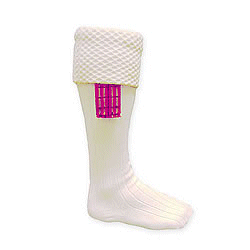
Pure white hose are actually not that common. The only times I normally see them are being worn by pipe bands at festivals and on parade, usually with the “popcorn” tops. Perhaps this is why some people believe that they should only be worn by pipers. Most of the hose that you will see are in fact an off-white or cream color. Sometimes I have people requesting pure white hose be ordered for them, out of concern that the cream hose will not match their white shirts. I always reassure them that the colors will match fine. It is the cream hose that you see men wearing most often, they look fine with white shirts, and if they were to wear pure white hose it would be quite noticeable (people might ask you where your pipes are!).

Some people choose to avoid the whole issue and avoid both white and cream colored hose entirely. And this is a good option. There are many colors under the sun to choose from, so why limit yourself? Personally, I prefer colored hose for casual wear, and either colored or diced hose for formal wear. I have to admit, though, that I do have a couple of pair of off-white hose in my wardrobe, for two reasons.

1. If I am wearing ghillie brogues for formal wear, the black laces show up much better against the light background of the cream hose than they would against, say, bottle green.
2. The off-white hose go with everything. This is a purely practical consideration. I have kilts in several different tartans, and I know that off-white hose will match whatever kilt I want to wear that day, even if my other hose are dirty.

Off-white hose continue to be the most popular today for both casual and formal wear for many reasons. One is simply that they are guaranteed to match any tartan. Other is that Highland dress suppliers offer these hose with much more frequency. If hose are included with rental kilt outfits, they will be off-white. Perhaps this use of off-white hose by the kilt-hire industry is why they have become so established for formal wear. So be it. Wear off-white hose if you like, but please do not feel limited to them.

Another downside to the light color hose (besides the fact that no one can agree on when they should or should not be worn), is that they tend to show dirt much easier. For those who wear their kilts primarily to Highland Games and other outdoor festivals, where it can either be dry and dusty or wet and muddy, this is an important consideration.

I usually recommend people purchase at least two pairs of kilt hose to begin with, off-white and a darker color. This is the least expensive part of the outfit, so why not splurge? Also, for most kilt wearers here in America, the most likely venue in which you will wear your kilt is a Highland Games, most of which are two-day affairs. Who wants to wear the same socks two days in a row?

So besides white or off-white, what colors are there to choose from? The most commonly seen are the dark bottle green and navy blue, the lighter lovat green and lovat blue, black, khaki (sometimes called tan, oatmeal, or stone in various catalogs), and gray. You’ll sometimes see other colors, such as red and burgundy. Any color that matches your kilt will be fine. In general, the darker bottle green, navy blue, and black will match most tartans in the modern colors. Lovat blue and lovat green will match most tartans in the ancient colors, but also look good with many modern tartans. Khaki, like off-white, tends to go good with everything.
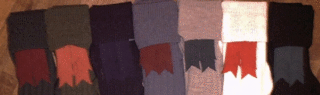

Besides just using your eye and seeing what looks good together, there are a few considerations. First, the darker colors like black, navy blue, and bottle green will look better for formal events than khaki or the lovat mixtures. These are merely loose guidelines, of course. There will always be exceptions. I was talking with a gentleman recently who was describing his formal outfit to me: a formal doublet made from his tartan in the weathered colors, a kilt in solid “weathered green” (really a brown) to match the color of his tartan doublet, worn with khaki hose that matched his kilt. I imagine the effect is quite stunning!

Garter flashes are another matter, and we will only touch on them briefly. Some people think they can skip out on them and save a few dollars, but besides adding a bit of color, they really are an essential item. The elastic garter keeps your hose from slipping, so unless you want to spend your day pulling your hose back up your leg, don’t forget the garters!

Though tartan flashes (to match your kilt) are very popular today, flashes are traditionally solid. I usually advise people to select a color hose that matches one of the dominant colors of their tartan, and flashes to match one of the colors of the narrow lines, if possible a line that lies on the color you chose for your hose. For instance, one of my kilts is in the Armstrong tartan, which has a red line on a blue ground. So blue hose with red flashes look excellent with this kilt. Green hose with red flashes also look good, for this tartan is mostly green.

The reverse is also true -- you can select hose to match a secondary color of your kilt, and flashes in your kilt's primary color to pleasing effect. In fact, this is a more common choice if your tartan is primarily red, such as Bruce, or MacDonald of Sleat. Red hose with green flashes would look fine with either of these tartans, but most people do not choose to wear bright red hose for casual wear, so green hose with red flashes are more usually worn.

(By the way, if you are having trouble deciding what color flashes to wear, just go with scarlet red. You can wear red with any tartan under the sun, even those with no red in them -- really! In The Kilt and How to Wear It, the only color garters Erskine mentions at all is scarlet, worn with any kilt.)

Hamish Bicknell, a frequent poster on the X Marks the Scot kilt forum, and full-time kilt wearer, has some good advice. His strategy is to match the color hose to the shirt you are wearing, and match the flashes to the dominant color of your kilt. In this way, your kilt is “framed” so to speak by your shirt above and your hose beneath. If your hose match your shirt, you can even get by with wearing a color that is not in your kilt at all. I've seen lovat blue hose paired with light blue or denim shirts to good effect, in tartans that are red and green.

This works very well, so long as the color of your shirt and hose is subtle. One point Hamish stresses is that you never want to wear anything that will distract from your kilt. Everything in your outfit should be chosen to compliment and highlight the kilt.

Good advice from someone who wears the kilt every day. Those of us who do wear the kilt frequently can tell you that this really isn’t that huge an issue. If you are worried about what color hose you can wear, you are probably over-thinking it. Use your eye. Use common sense. Try and select a color that looks good with your tartan, and if possible get several pairs so you can alter the color hose based on the shirt, tie, or jacket you are wearing. Keep the overall look of your outfit in mind. And if you simply have no eye for fashion, and you know it, don’t be embarrassed to ask. I wear the kilt all the time, and have a drawer full of kilt hose, and even I sometimes have to ask my wife, “Will these hose look good if I wear this shirt?” She’s the one that must be seen with me, after all!

Friday, July 22, 2005

Clergy Tartan

It seems that suddenly I am having a number of different people asking me about the Clergy tartan. Who can wear it? Why are there different versions? Where did it come from?

After researching it a bit, I thought it might be of interest to post my findings here. First of all, so that we know what we are talking about, this is the Clergy tartan that most people are used to seeing.

There is a green version, as well, that you will sometimes see. But of the different versions of the Clergy tartan on record, these are the only two commonly woven.

The Clergy tartan is often said to be the only tartan intended for use by an occupation, and not a clan, family, district, corporation, etc. There is long standing and oft-repeated statement that the Highland clergy wore Highland garb, but were told to eschew the brighter colors. Now, I've never been able to determine if this was indeed true, but have no reason to doubt it. James Scarlett, who knows as much about tartan as anyone living, is of the opinion that the Highland clergy wore whatever tartan the local hand weavers were producing, just like anyone else.

Anyway, when we start getting into the nineteenth century, with industrial weaving and set named patterns and the like, we find the first record of a tartan named "Priest." Wilsons of Bannockburn, the primary producer of tartan cloth at the time, and the first mill we have record of that named their tartan patterns, has a record of a tartan by this name -- our best guess is that they simply thought "Priest" a suitable name for a muted tartan. Theirs was a tartan that was black, lavendar, and light blue. (No. 246 in the International Tartan Index, or ITI).

James Logan apparantly got hold of the design, and reproduced it in his The Scottish Gael, published in 1831, under the name "Clergy." But his design was a bit different. He seems to have gotten one of the pivots wrong, and changed light blue and lavendar to white and grey. (No. 1823).

William and Andrew Smith published The Authenticated Tartans of the Clans and Families of Scotland in 1850, and included the Clergy tartan, as well. They attempted to reproduce the tartan as given by Logan, but with the original lavendar and blue colors. They used a color that would pass for lavendar, but they sometimes mistakenly used it for two or three stripes that should have been black. Also, the light blue in some copies of their book turned out a greenish grey. Variations occurred from one edition to the next, and sometimes between copies of the same edition, so this caused a lot of confusion later on. (Nos. 39 and 111 are both from the Smiths' work).

The next time the tartan was illustrated was by James Grant in 1886, in The Tartans of the Clans and Septs of Scotland. He illustrated the light blue lines right, but the lavendar in the original had turned into a clear blue, and he used it for two lines that should have been black, apparantly copying the error from one of the Smiths' books. But in the text for his book, he says that the Clergy tartan was white, black and grey. This seems to indicate that he intended to illustrate the tartan from Logan's work, but the publisher substituted a different illustration. In later editions of his book, the text described the tartan as dark blue, light blue, and black, but in the illustration this time light blue was rendered as green! This is probably where tartan 701 fits in.

Lastly, in the first edition of The Setts of the Scottish Tartans D. C. Stewart attempted to make a compromise between the original Wilson sett and Logan's sett, but this had the undesired effect of creating yet another variation on the market, so in later editions this was amended.

The connection with the Clark tartan is due to the fact that both the surname "Clark" and the word "Clergy" have the same root in the Latin word clericus from which we get "cleric" and "clerk." The Clergy tartan seems to have been used by the Clark family for that reason. In fact, in many of the nineteenth century works I cited, the tartan is called both names. The practice today of producing the Clark family tartan in different shades than the Clergy tartan is probably just to allow for distinction between someone wearing the tartan because they belong to the Clark family, and someone wearing the tartan because they are a minister.

So then, who can wear the Clergy tartan? Well, as I have said before, there is no such thing as an "entitlement" or a "right" to wear a tartan. There are no laws where this is concerned. But just because you can wear any tartan, does not mean that you should wear any tartan. In today's culture, tartan is generally understood to be representative. When you wear a tartan, you are identifying yourself with what that tartan represents. Why you may choose to wear a particular tartan is completely up to you -- but you don't need to be able to present a pedigree to prove your "right" to do so.

In the case of the Clergy tartan, wearing this will imply to people that you are involved in ministry. Out of respect for those who actually are ordained clergy, most people would consider it very innapropriate for a non-minister to wear this tartan.

But for those in the ministry, any Clergy tartan will do. Just wear the one you like the best (though you will find that if you want anything other than the blue Clergy tartan, you may have to have the cloth woven.

I have heard it said that certain variations of the Clergy tartan are for Catholics and others are for Protestants. This is unfounded. To my knowledge, the Clergy tartan has never been restricted for members of one particular sect or denomination. Of course the two main religious bodies in Scotland are the Presbyterians (Church of Scotland), and Catholics, followed third by Anglicans (Church of England).

The only denomination-specific tartan that I know of is the Episcopal Clergy tartan, designed (according to the notes in the ITI) "by Rev. John B. Pahls, 1966, to honor the clergy of the Scottish Episcopal church and of the Episcopal Church in the United States of America and to commemorate the bicentenary of the death of the Right Reverend Samuel Seabury, first American bishop."

So, if you are Episcopal Clergy, you might want to wear that tartan, or the other Clergy tartans. But other than that, the Clergy tartan can be worn by any man of the cloth! Not that members of the clergy have to wear Clergy tartan. I know many ministers and priests who wear their clan tartans. I have often thought that a solid black kilt would look stunning with clerical dress. And I have sold one "Dark Douglas" kilt (Lochcarron's black on black version of House of Edgar's "Dark Isle" tartan) to an Anglican minister, who wanted a solid black kilt, but also wanted a tartan.

Friday, July 15, 2005

Sharp Dressed Man


Many of you wanted to see a picture of Pat McCabe, whom I mention in my post after the Gatlinburg Scottish Festival as being one of the best dressed people there. Pat is not afraid to match pattern with pattern, and he does so in such a way that he truly looks like a Scottish gentleman out strolling his estate.

I ran into Pat again recently at the Grandfather Mountain Highland Games, and he was well dressed, as usual. Here he is wearing a new tweed jacket he had made fom cloth from The House of Edgar. Note that his kilt (MacLeod "Snuffbox" tartan), shirt, tie and jacket all have a different pattern. (The sunlight makes the small pattern on his shirt difficult to see in this picture).

Of course you cannot simply wear any pattern with any other pattern and have it look nice. But Pat here is a grand example of how authentic one can look if you have an eye for color tones and a good fashion sense.

Friday, July 01, 2005

Oh dear!

While doing a web search for something completely unrelated, I came across this article from Irish Roots magazine:
http://www.irishrootsmagazine.com/about/KiltFacts.htm

It is posted as a sample of the articles their magazine features. This particular article is from their 2000 third quarter issue. It's written by Patrick F. Meehan and is entitled "Kilt Facts: The Irish National Dress."

To be blunt, I have never in my career seen such a large collection of errors and plain nonsense as is included in this brief (three pages if you print it) article. To begin with, even the title is wrong! The kilt is not the Irish National Dress. It is the Scottish National Dress. Yes, I know many Irish people wear the kilt -- so do the Welsh, the Cornish, the Manx. You'll find Englishmen, Germans, Spaniards and Italians in kilts nowadays. And that's fine. But they do so because they choose to adopt Scottish dress. None of this means that the kilt is the Welsh National Dress, or the German National Dress, or the Italian National Dress!

There is the myth that the kilt somehow originated in Ireland. I deal with this in my article on the early history of the kilt.
http://albanach.org/kilt.html
This version of the kilt's origins, however, was not even suggested originally by the Irish, but by Scots who wished to prove the great antiquity of their national dress by suggesting that it was brought over by their migrating Irish ancestors in the sixth century AD. Accurate historical accounts show this to be patently false (as my above article shows). But such is the root of this particular myth, which has since been picked up by many Irish, as well.

So I run across people all the time who consider the kilt Irish in origin. But this particular writer just had me floored with misinformation. One really needs to pick apart the article one sentence at a time to correct all the errors. To begin with:
The kilt is the national dress of the Celtic lands - Ireland, Wales, Cornwall,
Isle of Man, Brittany and Scotland. It is far more popular at the moment in
Scotland, where almost every clan has its own tartan.

We just addressed this above. The kilt is most certainly not the national dress of every land with a claim to Celtic heritage. The kilt originated in Scotland, over the course of the sixteenth, seventeenth, and eighteenth centuries -- long after any of the places Meehan mentions would have considered themselves part of some general "Celtic" culture. So of course the kilt is far more popular in Scotland than any of these other places -- that is where it was born!

The kilt was originally called the feileadh mor, a belted cloth of about twenty
yards and partly pleated.

The feileadh-mor, or belted plaid, was the original form of the kilt, being worn in Scotland from the end of the sixteenth century through the eighteenth. So Meehan is right that the original kilt was the feileadh mor, though it was worn in Scotland, not Ireland (in fact, the first reference we have to the feileadh mor in 1594 is an Irish document commenting that you could instantly tell the Scottish Hebridean soldiers from the Irish soldiers because of their dress -- the Scots were wearing feileadh mors and the Irish were not!).

But most ridiculous here is Meehan's claim that the feileadh was twenty yards long! That's sixty feet, for those who want to do the math. Can you imagine sixty feet of heavy wool wrapped around you! One would barely be able to stand up. In reality, the feileadh mors were, on average, four or five yards long. They were made from two widths of 25" to 30" wide cloth sewn together to make a single width of 50" to 60". So a four yard feileadh mor would have been made from eight yards of single-width cloth. But even assuming Meehan here is referring to twenty yards of single width cloth, cut and sewn together to make a double width feileadh, that still leaves us with a ten yard (30 feet) length of cloth -- twice what was actually worn.

Many of the Norsemen who came to Ireland began wearing the kilt,
particularly the nobility. The famous king of Norway Magnus Barelegs, who
spent some years in both Ireland and Scotland, always wore a kilt.

Ok, so it is not enough to have the early Irish wearing the kilt, but now the Norse are getting in on the action! This is really too silly. The reference to Magnus Barelegs (more commonly called Barefoot) is from a 1093 account of his life that speaks of him and his soldiers adopting the garb that they encountered in the Western Isles of Scotland. It reads, "they went about barelegged having short tunics and also upper garments, and so many men called him ‘Barelegged’ or ‘Barefoot.’" That's it. Did you see a kilt mentioned? No, but most assume that if he was in Scotland, and barelegged, then he must be wearing a kilt, regardless of the fact that the kilt wouldn't be invented for centuries yet to come.

In the fifteenth and sixteenth centuries men in Ireland and Scotland began
wearing shirts and the kilts were changed to the feileadh beag or brat beag
similar to the modern kilt and consisting of about 10-12 yards owoolenllen
garment.

Oh, so many errors! First of all, the feileadh mor was not worn until the late sixteenth century. The feileadh beag, the next development in the kilt, came about sometime between the late seventeenth and mid eighteenth century, depending on who you read. We don't really know. But the suggestion that it was worn in the fifteenth century is absurd.

Second, like the feileadh mor before it, the feileadh beag was worn in Scotland -- not in Ireland.

Third, the feileadh beag, like the feileadh more, was about four yards long, though only 25" to 30" wide. It most certainly was not ten or twelve yards. Even the modern day kilts that have much, much, more cloth than the original feileadh beags, have no more than eight yards of cloth for an average sized man. Even very robust men have no more than nine or ten yards.

The first person to wear a tartan or multi-coloured kilt was King James III
of Scotland who reigned from 1460 till his death in 1488.

Er... no. I'll be repeating it often I know, but the very earliest reference we have to someone definitely wearing a kilt comes from 1594. So James III must have been a ttravelerller. Or the author of the article is misinformed -- whichever is more likely.

In Scotland today almost every clan or family has its own tartan. Some of them
have a few different kinds i.e. the chief's tartan, the clan tartan, the working
tartan, the hunting tartan, the ceremonial tartan, etc.

Yes, most clans and families in Scotland do have more than one tartan. But I don't know where Meehan is getting his classifications. In all my years in the business, I've never heard of a "working tartan" or a "ceremonial tartan." A very small number of clans have true "chief's" tartans. The most common classifications of tartans are dress and hunting, but these refer to the colors of the tartans, and not any actusageeage. (Hunting tartans generally have more green, dress tartans more white, etc.)

Very few Irish clans had their own tartan. Among the clans that had were tFitzpatrickicks, princes of Ossory, and later barons and earls of Upper Ossory in
Queen's County (now called Laois). They had no less than five tartans. The
O'Murphys of Wexford, the O'Kennedy's of Ormond (North Tipperary) and a few
other families.

No Irish clans had their own tartans. Scottish clans didn't either, until the named tartans started to be fashionable in the late eighteenth and early nineteenth century. See my article on the "Sources of the Tartans."

http://albanach.org/sources.htm

The idea that Irish families might have tartans did not come about until the twentieth century. In 1977 the late William H. Johnston supposedly gave the Scottish Tartans Society information on a number of Irish name tartans that he found in an 1880 book called Clans Originaux held by the Pendleton Woolen Mills in Oregon. It was supposed to be the earliest record of Irish tartans. However in 2003 members of the Scottish Tartans Authority were allowed to examine photos of the book only to find that it included only well-known Scottish tartans and no Irish named tartans at all! So where did these tartans come from? Just a figment of someone's imagination? Who knows. But all the Irish named tartans for which we know the origin are definitely modern.

Fitzpatrickicks, for instanwhomhome Meehan claims had no fewer than five tartans, have exactly two on record. One that is supposedly from the Clans Originaux (which we now know to be false) and a second which is a more recent variation on the first. I've got no idea where Meehan might have gotten three mFitzpatrickrick tartans from.

In 1880 a book, Clan Originaux was published in Paris by J. Claude Fres et
Cil and it had a number of Irish clan tartans in it. It is long out of
print.

As I have already stated above, this book was examined in 2003 and absolutely zero Irish tartans were found. You can read about this book (and see a list of all the tartans it does contain) here:

http://www.tartansauthority.com/Web/Site/Tartan/Research/ClansOriginaux.asp

However, this information only came to light in 2003, and Meehan published his article in 2000, so he can be forgiven for not knowing. One other correction -- Clans Originaux was never published as a book. It is really a collection of tartan samples; what we would call a "swatch book" today. One that you might see when you enter a Scottish import store or a kilt maker's shop. Who J. Claude was, and why he put together this collection of tartan samples in Paris in 1880 is still a bit of a mystery. But one fact can be put to rest. He included no Irish tartans.

It is said that King James II granted the use of a special tartan to each
county in Ireland in 1689

Well, I have no idea who said it. That's the problem with articles like this that make odd claims and give no references. How can one possibly be expected to verify sources when the only reference is "it is said..." In any case, since the earliest recorded evidence of any standardized tartan patterns was for the Scottish military in the eighteenth century, I find it extremely far fetched that James II (or VII, depending on when you start counting) assigned set tartans for each county in Ireland in the seventeenth century.

The Irish County Tartans that you see today that are so popular were all designed in the mid-1990s by Polly Wittering of the House of Edgar and, though attractive and very popular, are entirely modern in design.

After the Battle of Culloden in 1645, Scots were fined for wearing the kilt;
in fact it was forbidden to wear it.

Um.... Culloden was in 1745, about a hundred years after Meehan has it. Maybe it's just a typo on his part (one that slipped past the editors of the magazine). If this were an isolainaccuracyracy, I'd forgive it. But given the many other historical doozies included in this article, you just never know....

In order to keep recruits in the army, King George. II allowed the
majority of Scottish regiments to wear the kilt and they became known as
'the ladies from hell'.

"The Lady's From Hell" is a name given by German soldiers to the Black Watch Regiment during WWI, long long after the period Meehan is discussing here.

Around 1820 Sir Walter Scot, the famous writer, defied the powers-that-be
and wore a kilt in public.

Is this the same Sir Walter Scott that once said, "Didancestorstors wear the kilt? Of course not! They could always afford trousers!" In any case, I don't think the "powers that be" would mind anyone wearing a kilt. Proscription was lifted in 1782, so I think that Sir Walter Scott would have been quite safe to wear a kilt thirty-two years later.

In 1822 King George IV paid a state visit to Edinburgh and Sir Walter
persuaded him to wear the Royal Stuart tartan, which he did. Then the nobility
all turned up for royal receptions in Edinburgh Castle and Holly rood Palace in
their kilts and clan tartans. It was again fashionable and the thing to wear a
kilt on every special occasion.

This section is more or less right! Let's all stop and applaud the author's success here for a moment, shall we?

Following this Meehan comments on a number of late nineteenth and early twentieth century Irish figures and their propensity to kilt wearing. Most of the kilts mentioned are solid colors, such as saffron and green. To comment on this, I will say that yes, the kilt was being worn at this time as a sign of Irish nationalism. However, the adoption of the kilt by people in the late-nineteenth century who were under the impression that the kilt was the ancient garment of thancestorstors does not make it true!

A friend of mine, Todd Wilkinson, makes this comment on the X Marks the Scot kilt forum:

"Several of the Irish revolutionaries of 1916 did this very thing [adopt the
kilt]. Patrick Pearce, the leader of the Easter Rebellion, even adopted the kilt
as a uniform for his school for boys, St. Enda's, which was supposed to
educate Irish boys on "traditional" Irish culture. From what I have read,
the boys took quite a few beatings from local boys over their kilts. Eamonn
Ceannt, another leader in the '16, reportedly played the uilleann pipes for
the Pope dressed in a green kilt. Another Irishman, Pierce O'Mahony, wore a
green kilt & is pictured in "ancient" Irish dress, complete with wolfhound. O'Mahony lived in Bulgaria and is quite the national hero there -- a tartan was recently introduced in his honour."

So I'm not disputing Meehan that people in Ireland did, about a hundred years ago, adopt the kilt as a sign of Irish nationalism. I'm just saying that this does not prove or support his claim that the kilt is an ancient form of Irish dress. All it means is that a lot of people a hundred years ago thought that it was.

Finally, we will return to our article, which ends:

In Dublin, one will find men wearing St Patrick's tartan and county
tartans during the summer months. Yet it would be easier to find a needle in
a haystack than buy an Irish county tartan kilt in Dublin. In seems most
Irish kilts and tartans are now supplied by MacNaughtons, kilt makers awoolenllen mills in Pillockey, Scotland.

It would seem that Meehan is bemoaning the fact that the Irish kilt is falling into disuse, when in reality it is more popular now than ever before! And even in his last sentence, he is in error. The Irish kilts and tartans he speaks of are supplied by MacNaughtons (The House of Edgar) in Pitlochry Scotland (not "Pillockey"), and that is for one very good reason. They were introduced by that firm in 1996 as a new line of fashion tartans, and they have the sole rights to produce those Irish County tartans. This just shows how new a thing this is.

As I state often when I encounter foolishness like this -- I am not disparaging anyone from wearwhatevertver tartan they like. I'm not saying not to wear an Irish County tartan, or an Irish name tartan, and I'm not saying Irish people shouldn't wear kilts if they so choose. I'm just saying recognize it for what it is. If you wear a tartan that was designed in 1996, accept that it was designed in 1996 and be fine with it. Don't go around creating false histories and spreading myths and legends that have been debunked long ago to try and give your new fashion some ancient pedigree.

Wear a kilt because you like it, it's comfortable, it's your heritage, or just because you want to wear one! You don't need sfancifiedfied reason to do so, and it only demeans you and the garment to persist in error.

Signing off for tonight....